
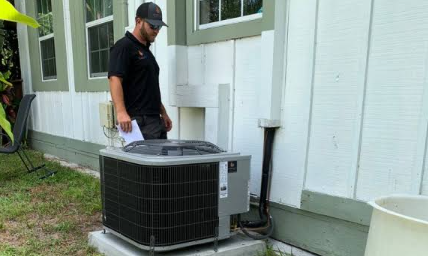
An air conditioner that quits during an August heat-index spike on Siesta Key has almost always failed at one of two points, the run capacitor or the refrigerant charge. Neither one means the system is finished. That is why an owner watching the thermostat climb past 84 degrees should book ac repair siesta key fl before anyone quotes a replacement. A vacation home makes the timing worse, because nobody is standing there when the fan stops. The house can sit at 90 degrees inside for two days before a cleaner opens the door.
August Heat Is When AC Systems Quit
Heat is the stress test. A condenser that ran fine through May loses its grip once the heat index sits above 105 for a week and the compressor never gets a night off. The Invading Sea reported in February 2026 that heat waves kill more Americans than any other form of extreme weather, with the CDC counting more than 1,000 heat-related deaths a year. Florida heat, that reporting noted, is intensifying. Inside a closed-up vacation home the indoor temperature follows the outdoor one within hours.
The case we see most often on an August no-cool call is a run capacitor swollen at the top. The runner-up is a slow refrigerant leak that finally drops the charge below what the system needs. Before you call anyone, pull up the National Weather Service HeatRisk map, which is free and shows how many days of load the house is facing. That matters for a rental. A Tuesday failure with a Friday check-in is a different problem from the same failure on a guest’s last morning.
See also: How Encryption Protects Data
What A Refrigerant Or Capacitor Failure Costs
Both failures are repairs, and both are cheap next to a replacement. Owners searching ac repair siesta key fl in August often brace for a five-figure number they do not need. Home warranty plans rarely close that gap either. CBS News, looking at whether a warranty covers a central AC unit, puts the usual HVAC coverage cap at $2,000 or $3,000, a fraction of what a full system swap costs. Read your own policy before you count on it.
Run the numbers on a capacitor call at a two bedroom rental off Midnight Pass Road. Say the after-hours diagnostic is $110 and the capacitor is $220 installed. The technician adds a pound of refrigerant at $95 to bring the charge back to spec, which comes to $425 before tax. A new 3-ton system for that same house might be quoted near $8,400 the same week. Those figures are an illustration rather than a quote, but the ratio between them holds on call after call.
The math almost never favors scrapping a system that failed on one part. Fix the part.
From Service Call To Cold Air Again
Two pieces of that repair are not a homeowner job. A run capacitor holds a dangerous electrical charge even after the disconnect is pulled, and refrigerant handling is federally regulated, so both belong to a licensed HVAC technician. If the breaker feeding the condenser trips again after one reset, stop resetting it and have the circuit inspected. Frequent breaker tripping and blown fuses sit on the Electrical Safety Foundation International’s list of warning signs of an overloaded, hazardous electrical system.
A same-day call usually runs like this. The technician confirms the fault at the condenser, then swaps the capacitor or repairs and recharges the leak. By the end of the first day the house should be pulling down toward 75 degrees. Within 14 days, check that the return filter is still clean and the line set is not sweating, since a fresh charge on a leaking system shows up quickly. By month three a repaired system holds temperature through the worst of the season with no change in run time.
The Maintenance That Prevents An August Failure
Prevention is a spring tune-up plus a look at the electrical side, not only the coil. US Fire Administration data on residential building fires attributes 47% of the electrical fires involving equipment to the building’s own wiring. A technician who spots scorched contactor terminals or a loose lug should say so out loud rather than button the panel back up. Salt air also corrodes pool cage screws and grill burners at this end of the key, though that is a different job on a different day. Back at the condenser, rinse the fins each spring and tighten the electrical connections. Replacing a weak capacitor before it fails outright is what keeps the August call from happening at all.
The pattern on Siesta Key is consistent. Systems quit in the hottest week of the year, the cause is usually one failed part, and the houses that ride through August are the ones a technician looked at in April. A repair call placed the morning the air goes warm costs a fraction of a replacement quote, and it protects the booking calendar besides. Keep the service records with the property file and note the model and capacitor rating. The next technician who shows up will diagnose it in fifteen minutes instead of ninety.

